

Seaside Pavilion on Chai Shan Island
Hello, ZhouShan
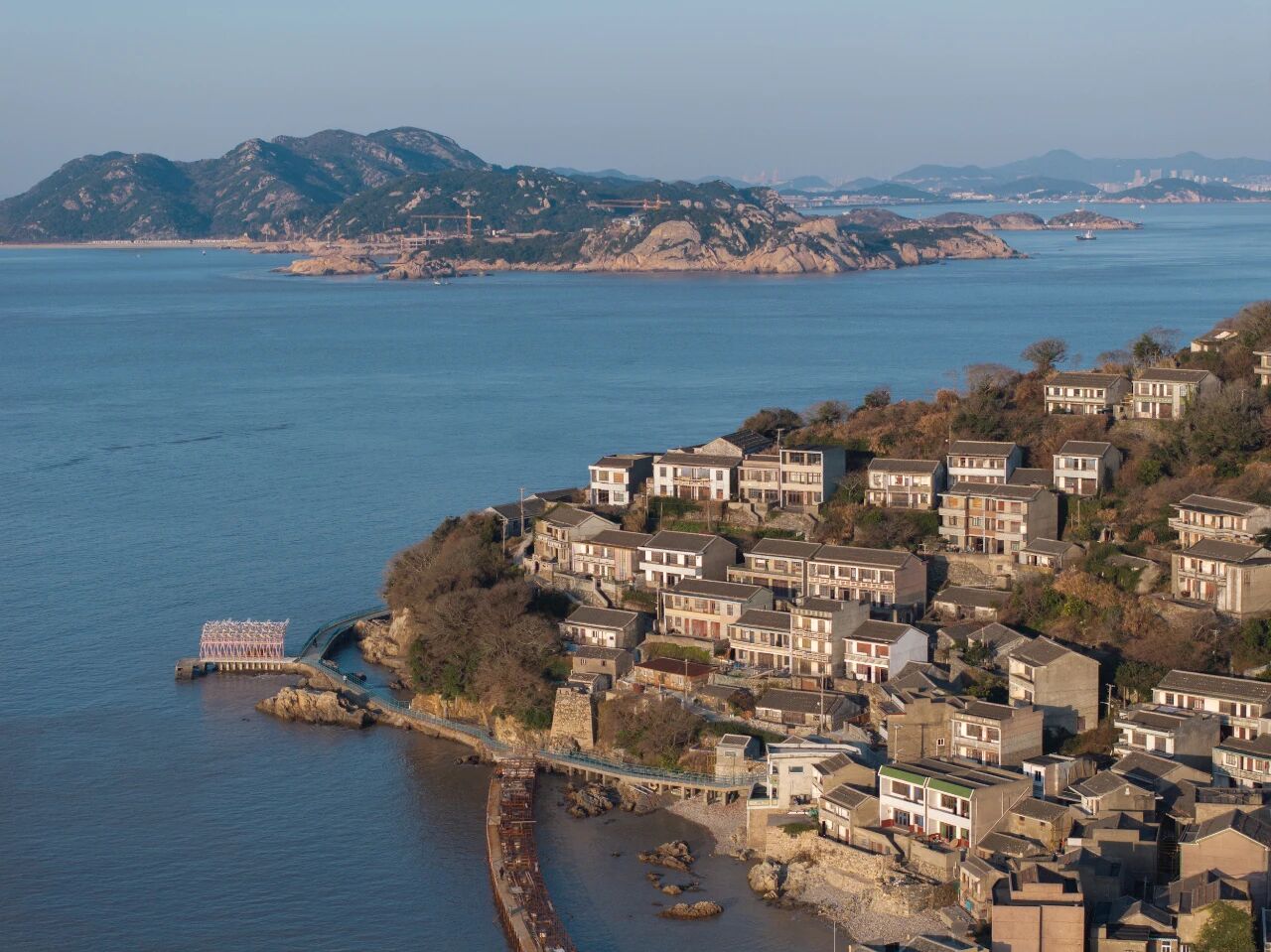
After most residents left the islands for life in the cities, only fewer than one hundred elderly people now live permanently on Chaishan Island. To revitalize the archipelago, Zhoushan launched the “Hello, Islands” Common Prosperity Initiative, with Chaishan selected as a second-batch demonstration island. Over ten new projects are planned here, bringing together art, design, fashion, and social interaction. Soon, new residents and visitors will arrive, and the island will begin to transform—its people, stories, culture, and landscape evolving together.
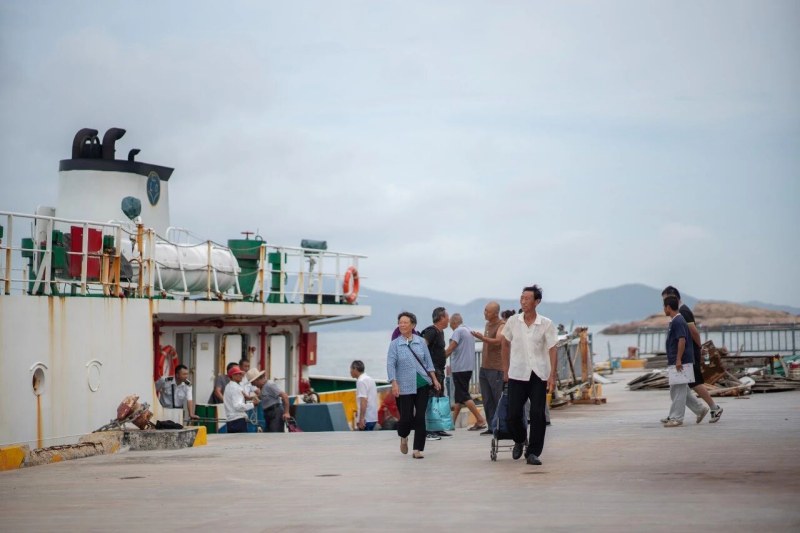
▲ Arriving crowds at the pier
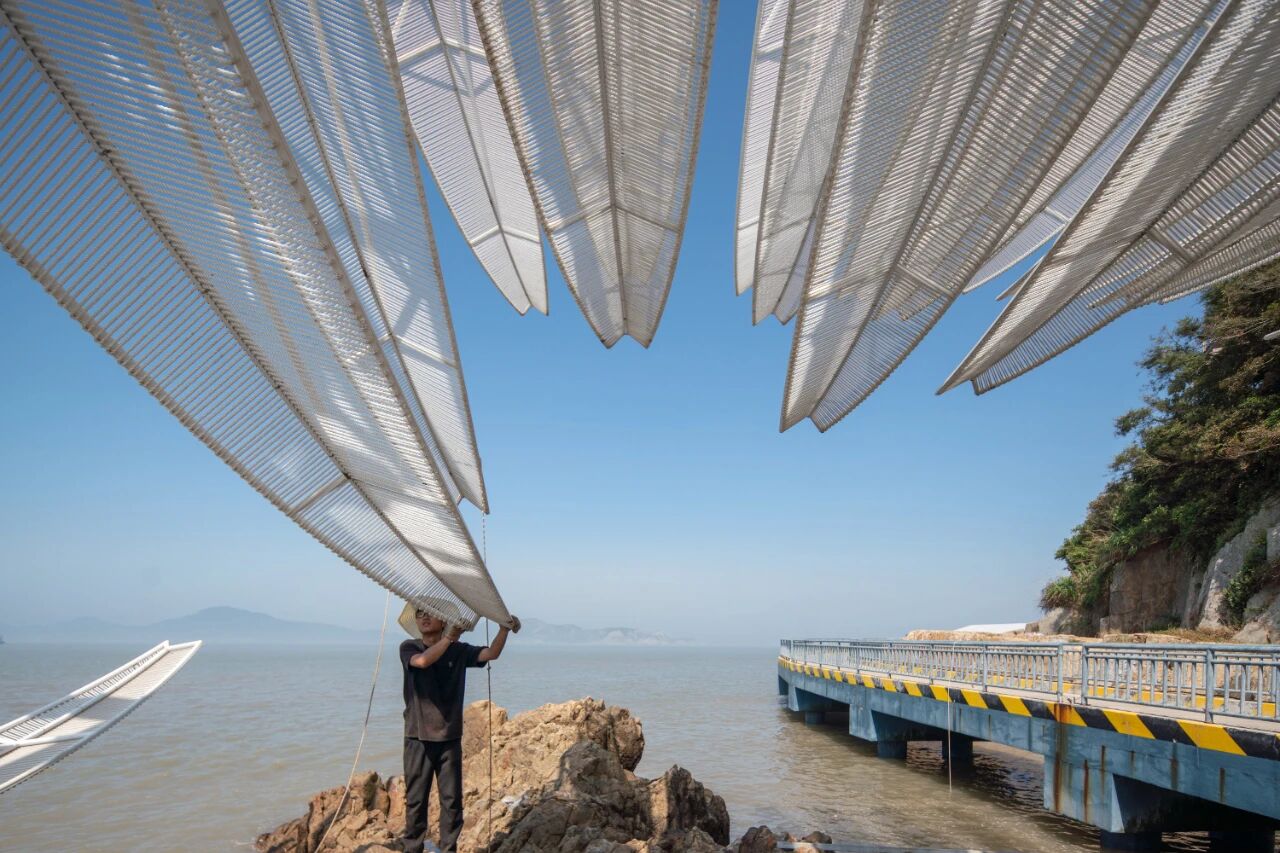
The Seaside Pavilion
Following the “Hello, Islands” competition, the Seaside Pavilion—the first-prize winning proposal—was realized, alongside a series of small architectural installations across other islands. Our design intention was to bring a sense of romance into the island’s humble daily life, capturing the spirit of poetic realism that grounds life and change in this era of transition.
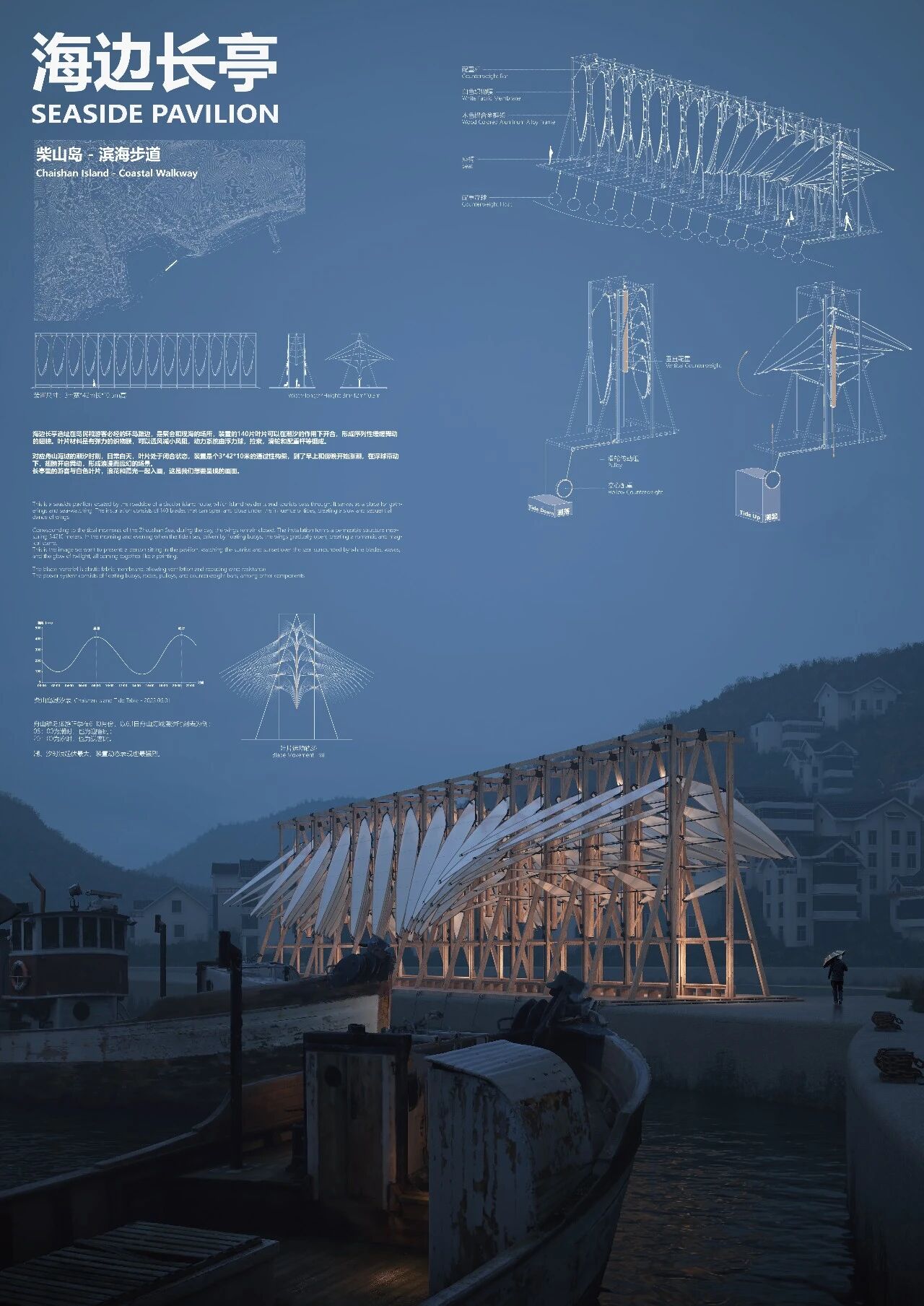
▲ Competition proposal / Petals rising and falling in rhythm with the waves
In traditional Chinese village imagery, a lush tree at the village entrance often serves as a landmark of arrival—visible from afar and a place where villagers gather, watch passersby, wait for guests, or bid farewell to loved ones. This enduring rural scene is beautifully described in the poem “Bu Suan Zi”:“The tide ebbs and flows without heart; people come and go again.From past to present, the long pavilion remains—The place where we send and greet each other. Generations come and go, yet beneath the pavilion, the tide endures.”
The pavilion installation is conceived to re-establish such a coordinate—a symbolic point of arrival and recognition at the island's entry.The original design proposed a tide-powered mechanism, allowing the pavilion's “leaves” to rise and fall with the sea. However, as visitors became the main audience, we optimized it to a wind-driven system, offering an immediate, perceptible kinetic experience.
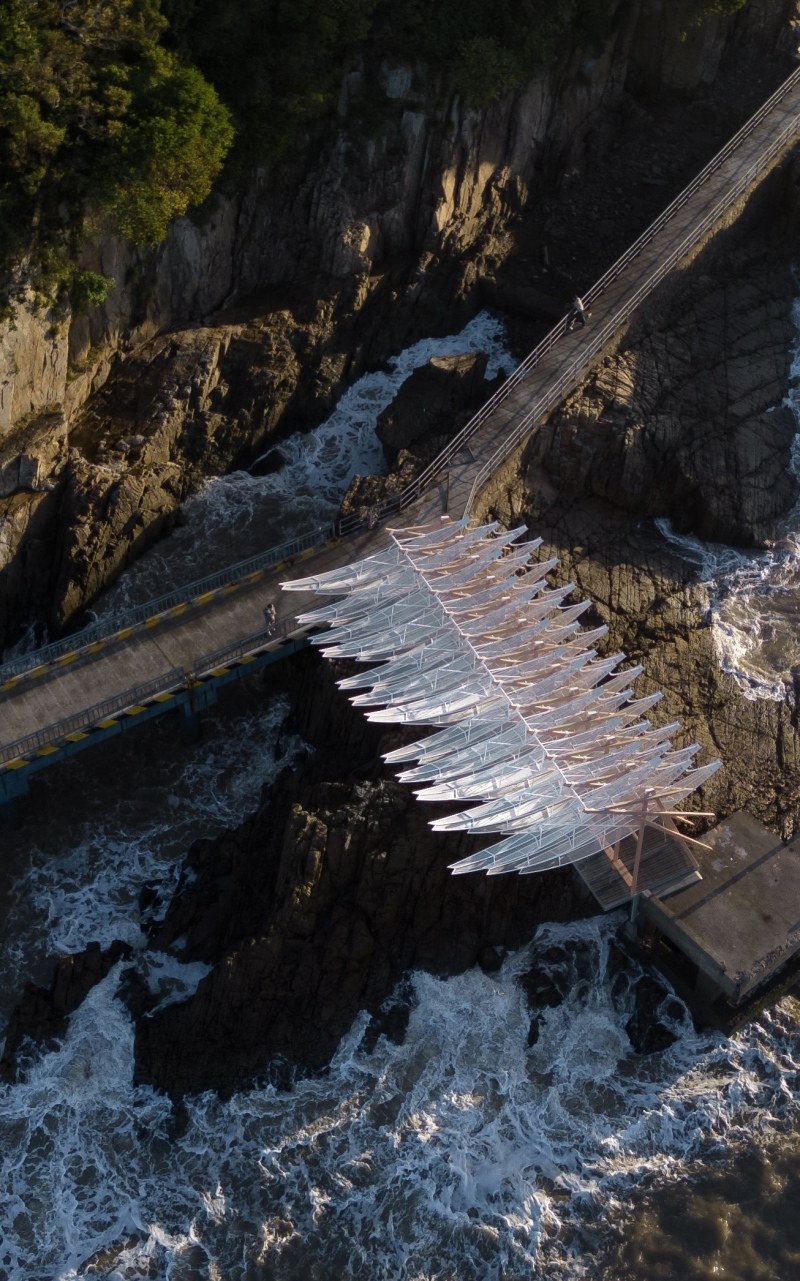
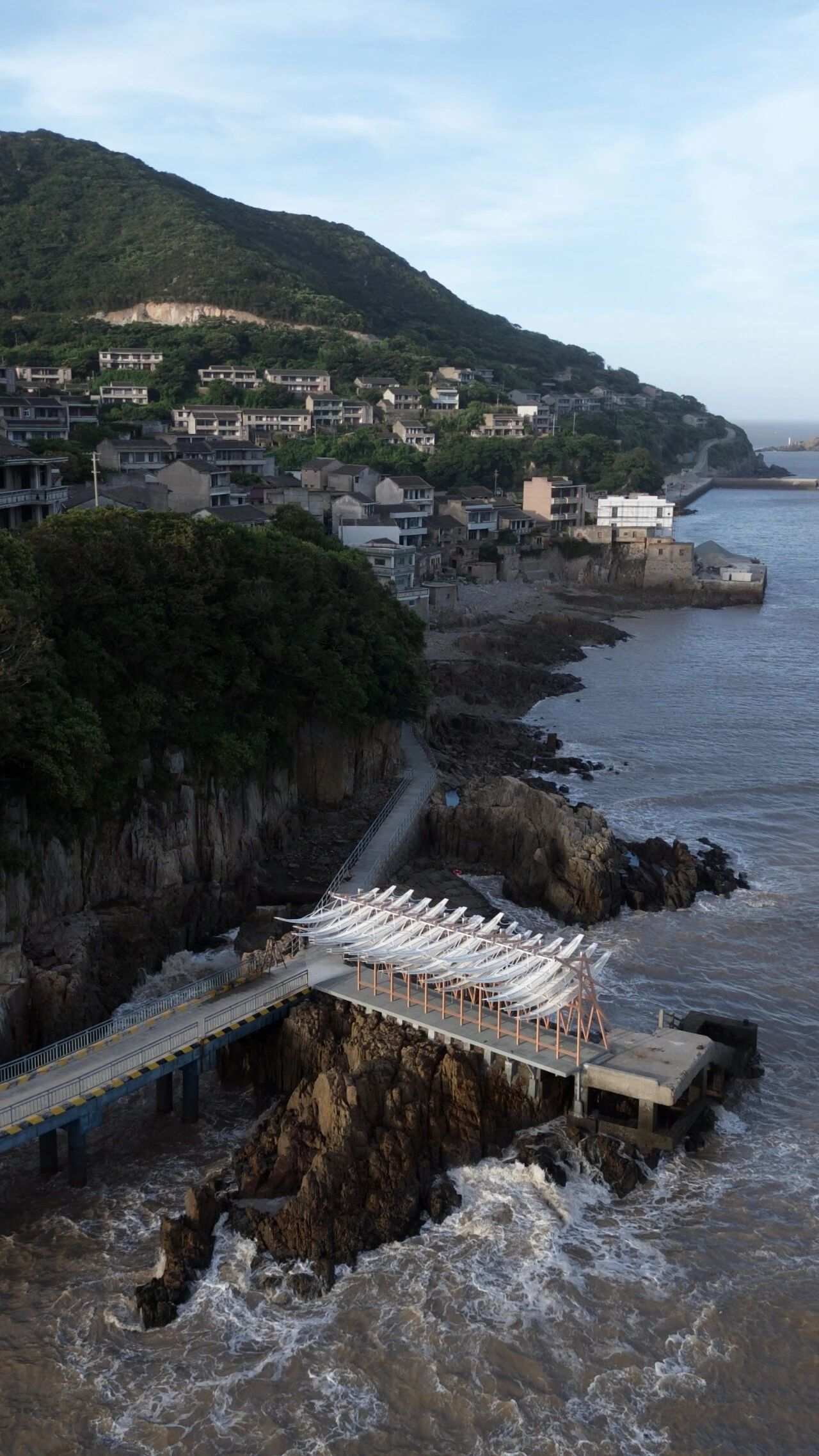
After multiple site surveys around the island, we selected an abandoned 1960s cargo pier—located between the new ferry terminal and the village. Surrounded by rugged reefs, with the sea and mountains as backdrop, the site offers a raw, cinematic setting.
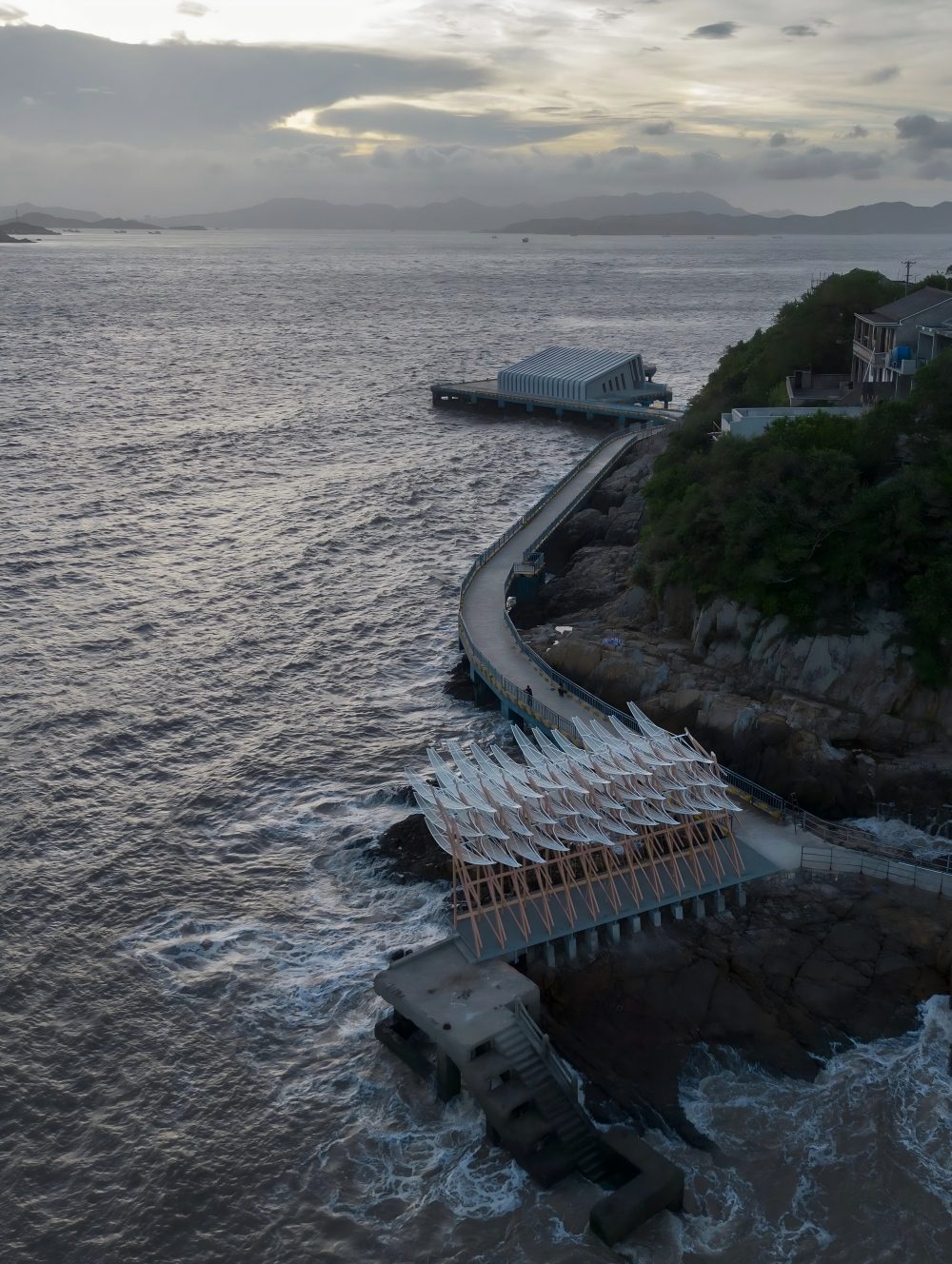
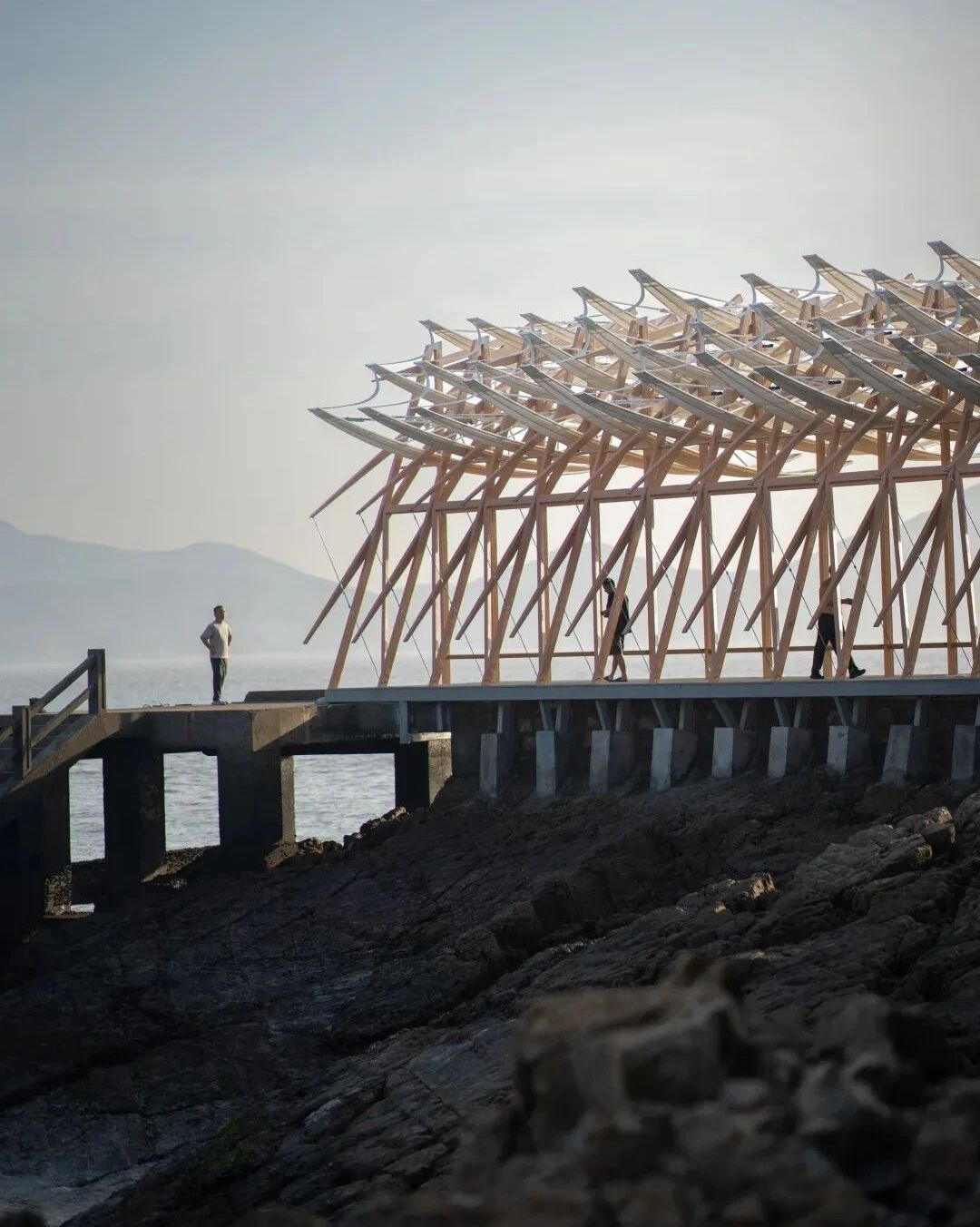
▲ Between the pier and the village
The Feather of Chaishan
Amid vast landscapes of mountains and sea, human scale and presence easily dissolve. Art installations reconnect people to place, grounding them in an emotional and spatial “presence.”
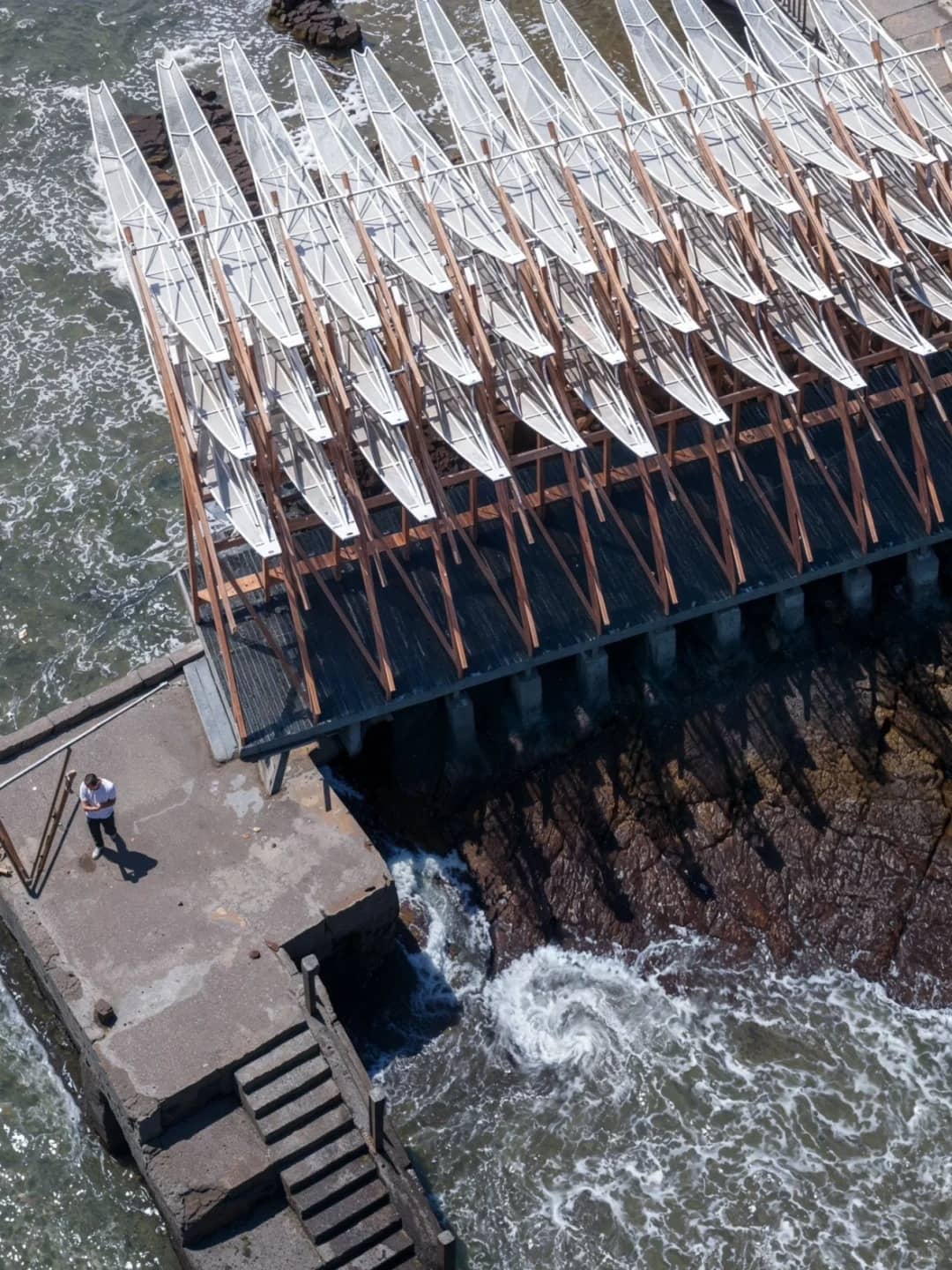
The design suspends multiple slender blades along a structural frame. In the sea breeze, they sway gently, echoing the rhythm of the waves—a poetic yet tangible construction of scenery. Beneath the swaying blades, the old pier walkway has been repaired and equipped with railings. In addition to the long-time fishermen who frequent the area, it has become a gathering and resting spot for local elders. Most sit quietly, gazing at the slow approach of each ferry and the brief flurry of voices as passengers disembark.
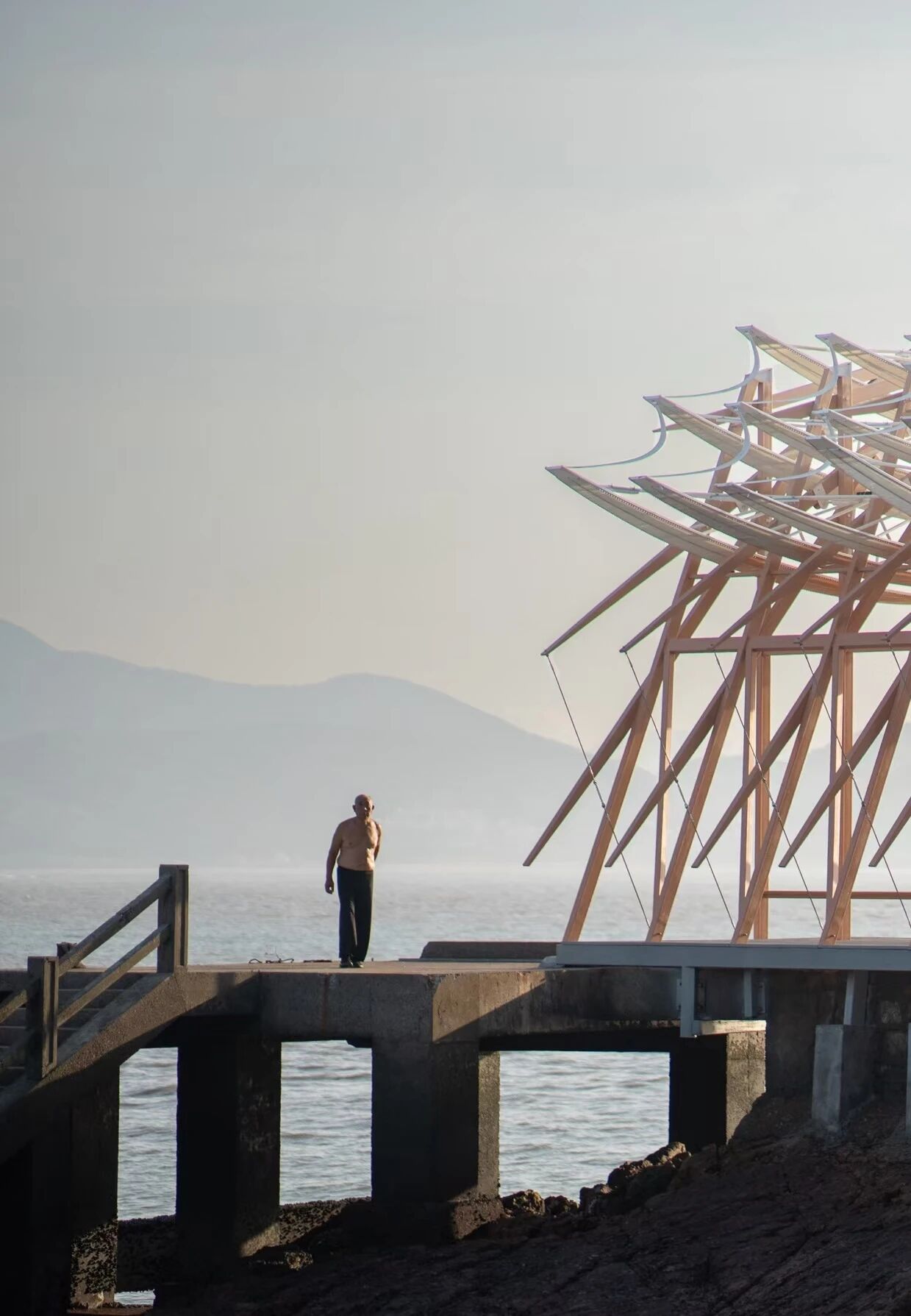
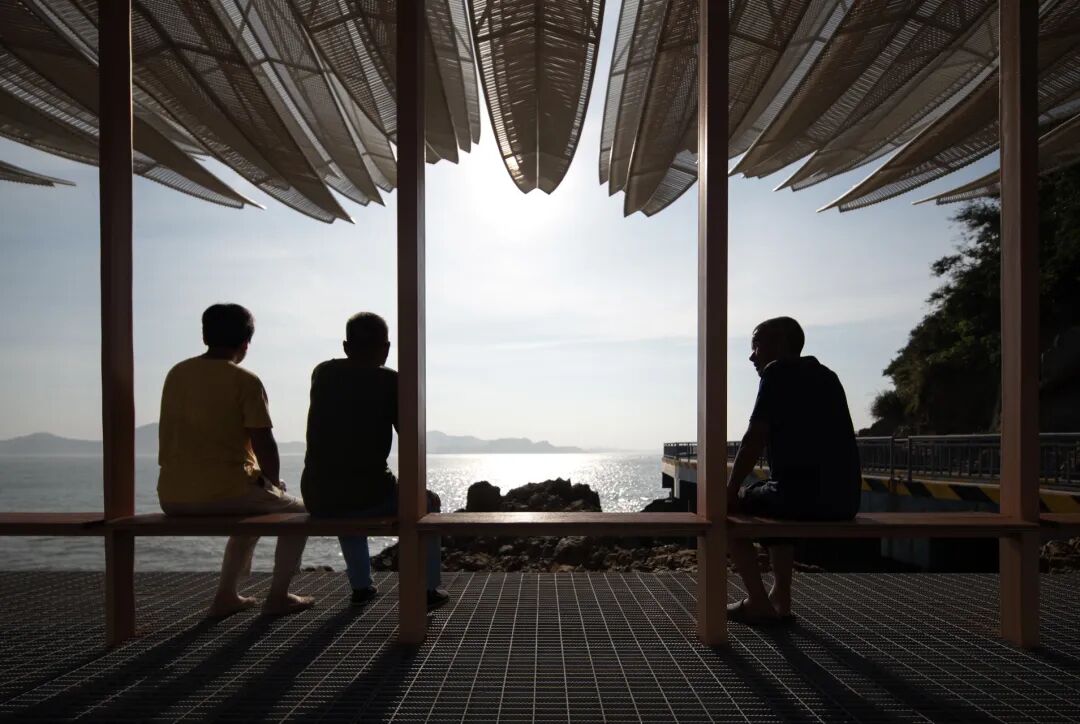
▲ The backdrop of island life
From August 15, 2024, when you take a ferry toward Baishan or Chaishan Island, you can spot this wind-powered installation from a kilometer away—like a white feather of the island shimmering in the wind.
Following the theme of poetic realism, the work builds on two layers of concept: The Pavilion as an emotional symbol—defining the installation's placement and spatial form. The Feather of Chaishan—a romantic metaphor that shapes its visual and kinetic character.
Set Up & Transport
The installation was prefabricated in a factory, transported in semi-finished parts by three large trucks over two days to Zhoushan, and then shipped to the island by a 300-ton cargo vessel and crane rented from local seamen. All construction tools and materials also had to be shipped in.
The structure comprises 36 blades, each 7 meters long, arranged in groups of three. Their initial balance was preset by counterweights, and the swing amplitude was carefully determined through dynamic simulation in Grasshopper.
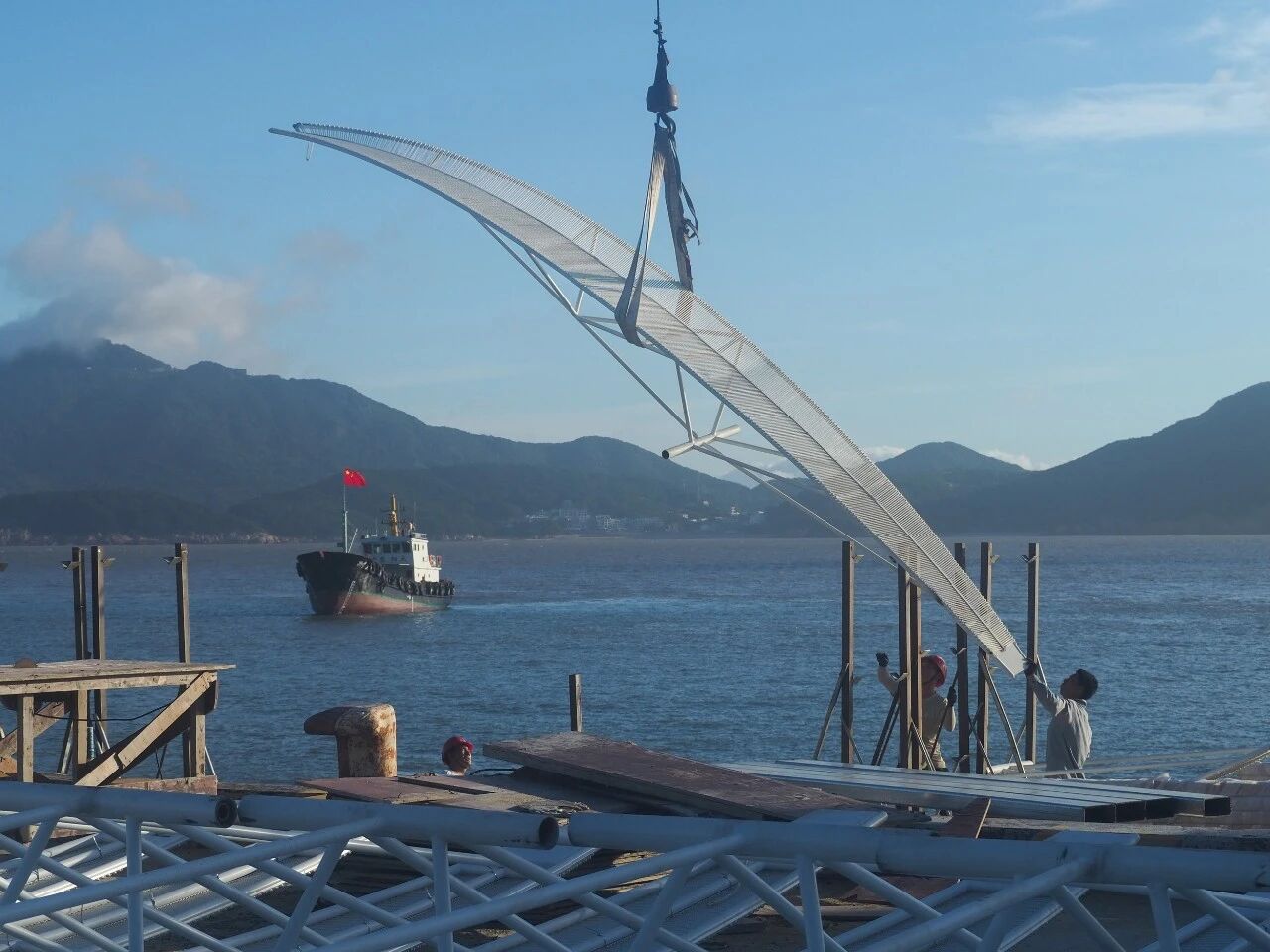
▲ Unloading semi-finished components at Chaishan pier
Each blade is mounted to the main frame via bearings, with primary and secondary counterweights at the tail to maintain equilibrium: the primary counterweight offsets the front cantilever moment, while the secondary fine-tunes the resting pitch. To prevent collisions between blades, linkages and rubber dampers were added—chosen for their simplicity and resistance to heat, sunlight, and corrosion.
Given the structure’s exposure to marine conditions—high salinity and winds exceeding force 10—the pavilion is made of welded steel with full anti-corrosion coating. The blades, initially planned in tensile fabric, were replaced with woven fishing rope, offering semi-transparency with greater strength and wind resistance.
The blades sway gently in breezes of force 3 and dance vividly at force 5 winds. During typhoons, they can be secured to form a rigid structure for protection.
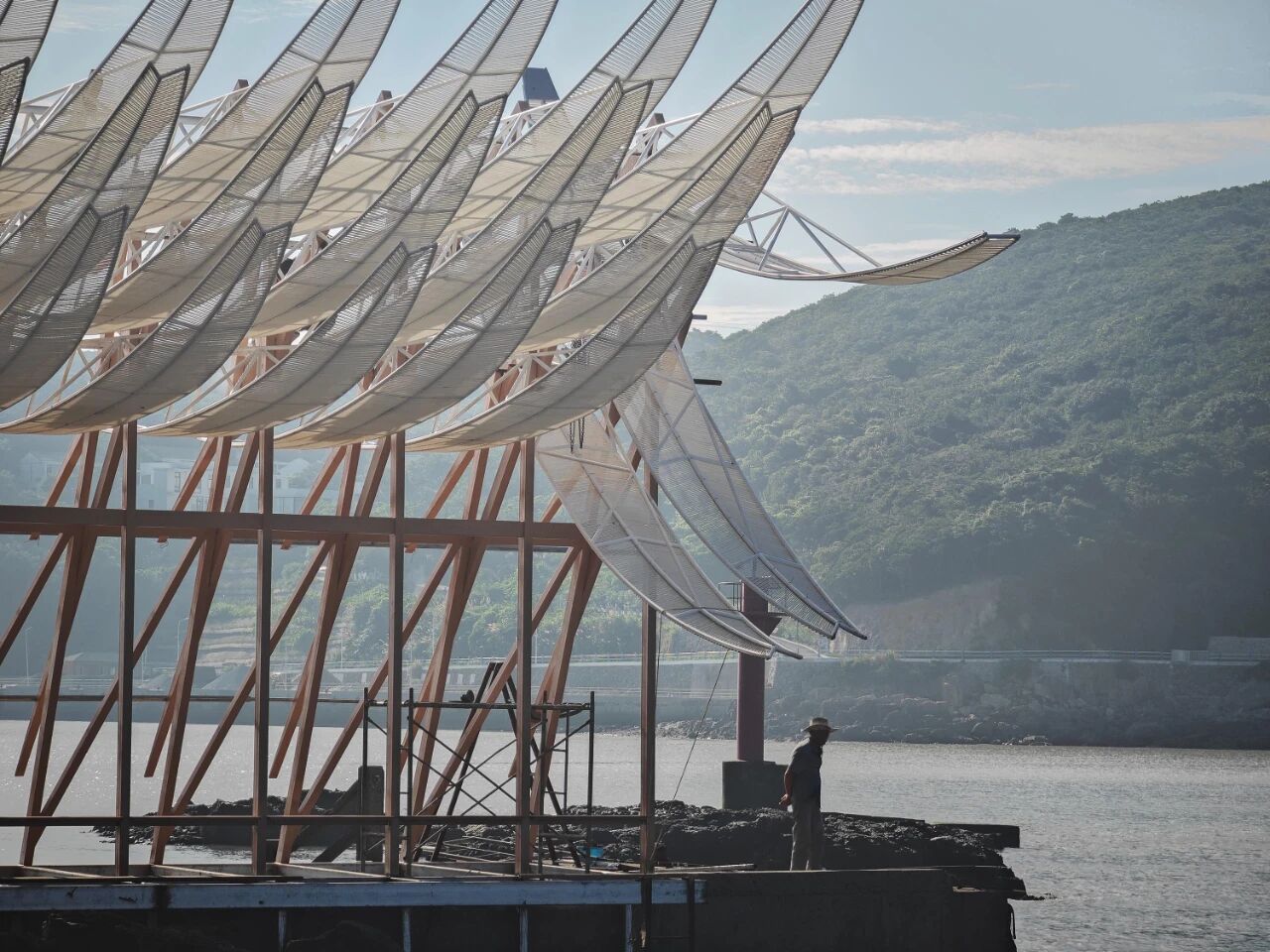
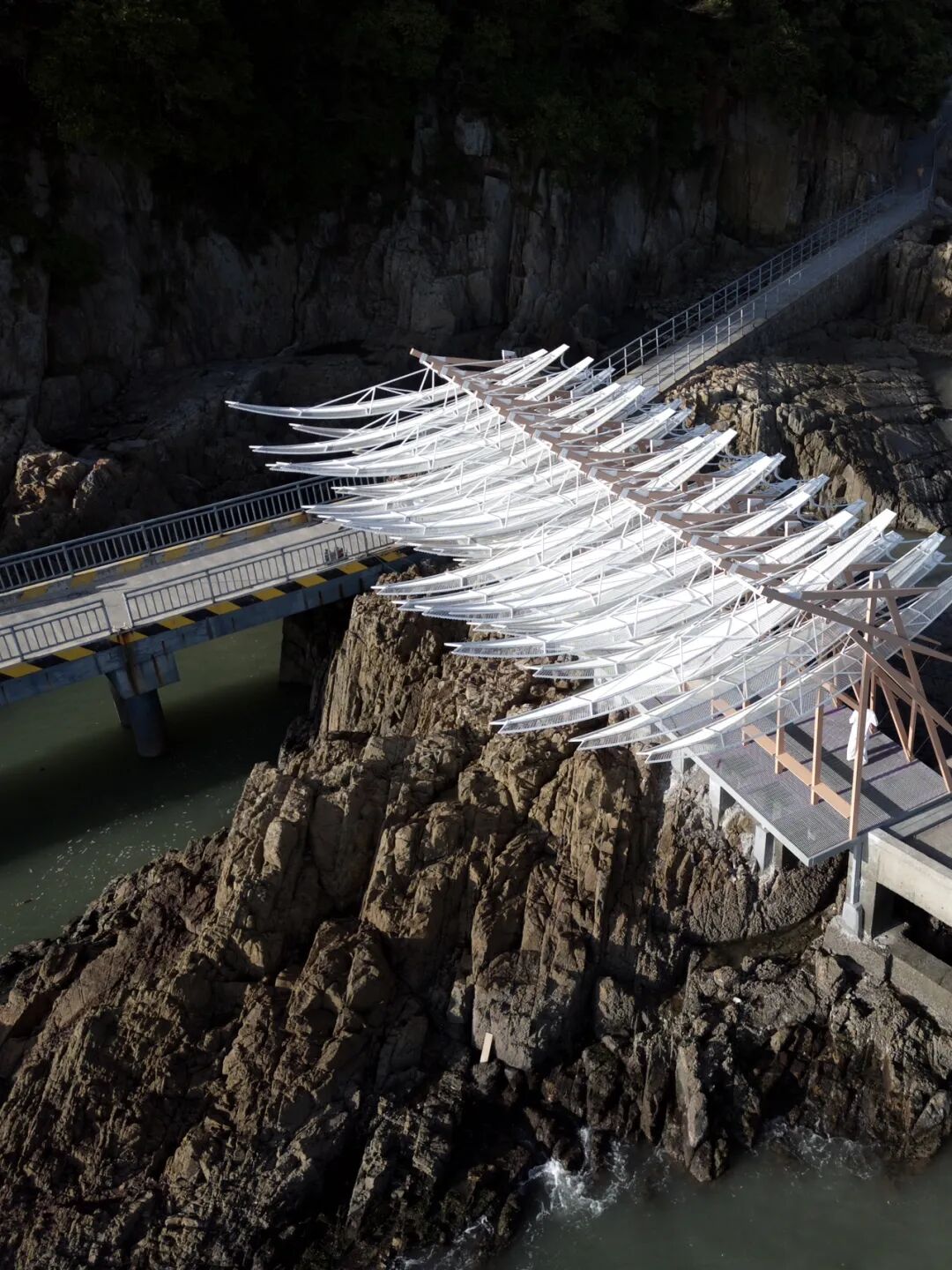
▲ Installation on the abandoned pier
Enduring the First Typhoon
Despite conservative structural calculations, we were most anxious about how the installation would perform under extreme weather. In the first week of construction, steel components and railings—tied and laid on-site—were blown into the sea by strong winds, taking two days to recover.
On August 20, just as installation was completed, a force 10 typhoon struck the island. All ferries were halted, and some team members were stranded on Chaishan. They recorded the installation’s condition through the storm—miraculously, it withstood the test unscathed.
As the wind howled and waves crashed against the rocks, the blades fluttered fiercely—a breathtaking scene of resilience and beauty.
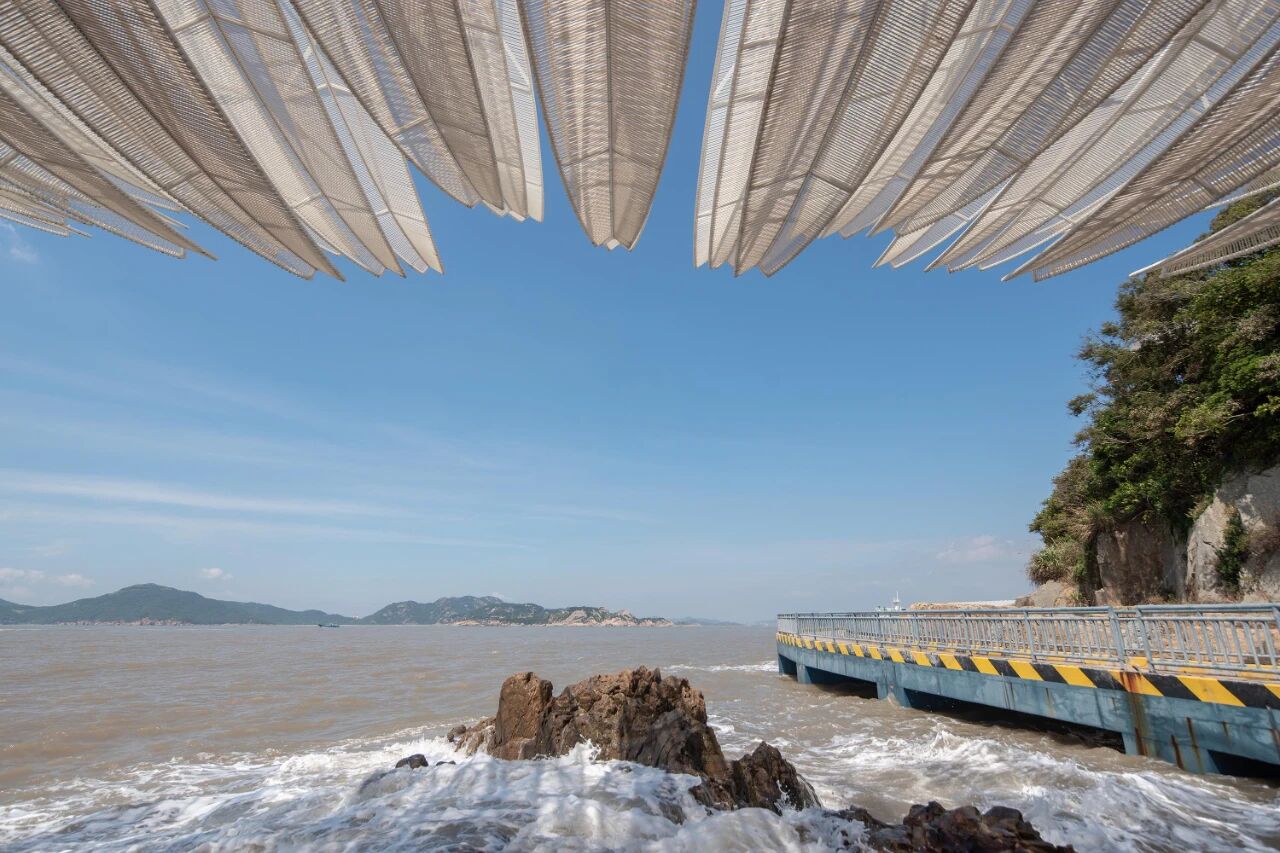
▲ Waves, rocks, and blades in the storm
Once Upon a Time
Chaishan Island was once covered in lush forests and has been inhabited for over two centuries. Fishermen passing by would land to collect firewood—hence the name “Chaishan,” meaning “Firewood Mountain.” As fishing prospered, more people settled here, and a harbor was enclosed to protect boats from storms. Residents called the village Gangli (“inside the harbor”), a name still used today.
Decades ago, the island thrived with over 1,600 residents, many from Ningbo, Zhujiajian, and Baisha, and others from inland provinces such as Anhui, Hunan, and Guangxi.
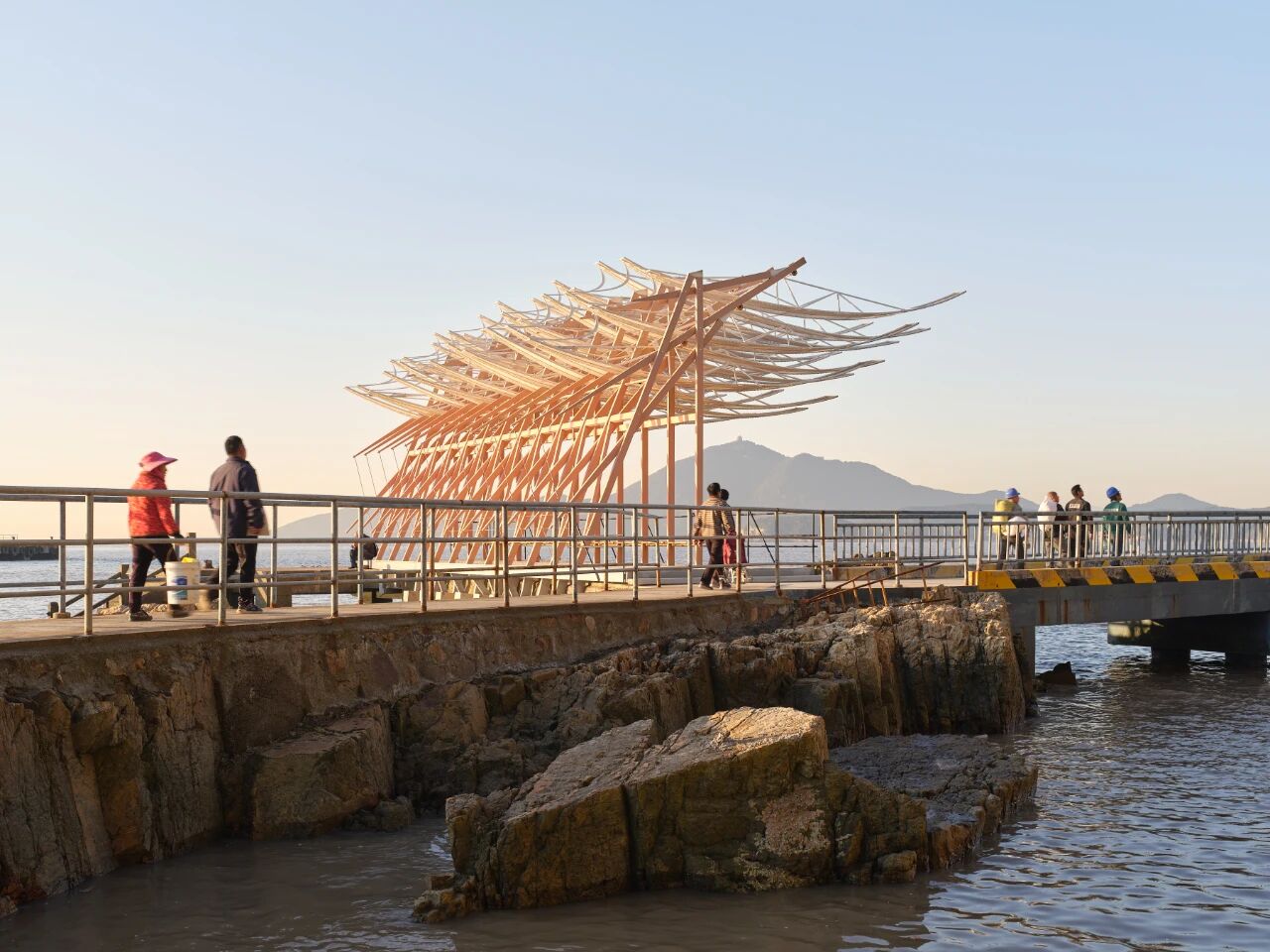
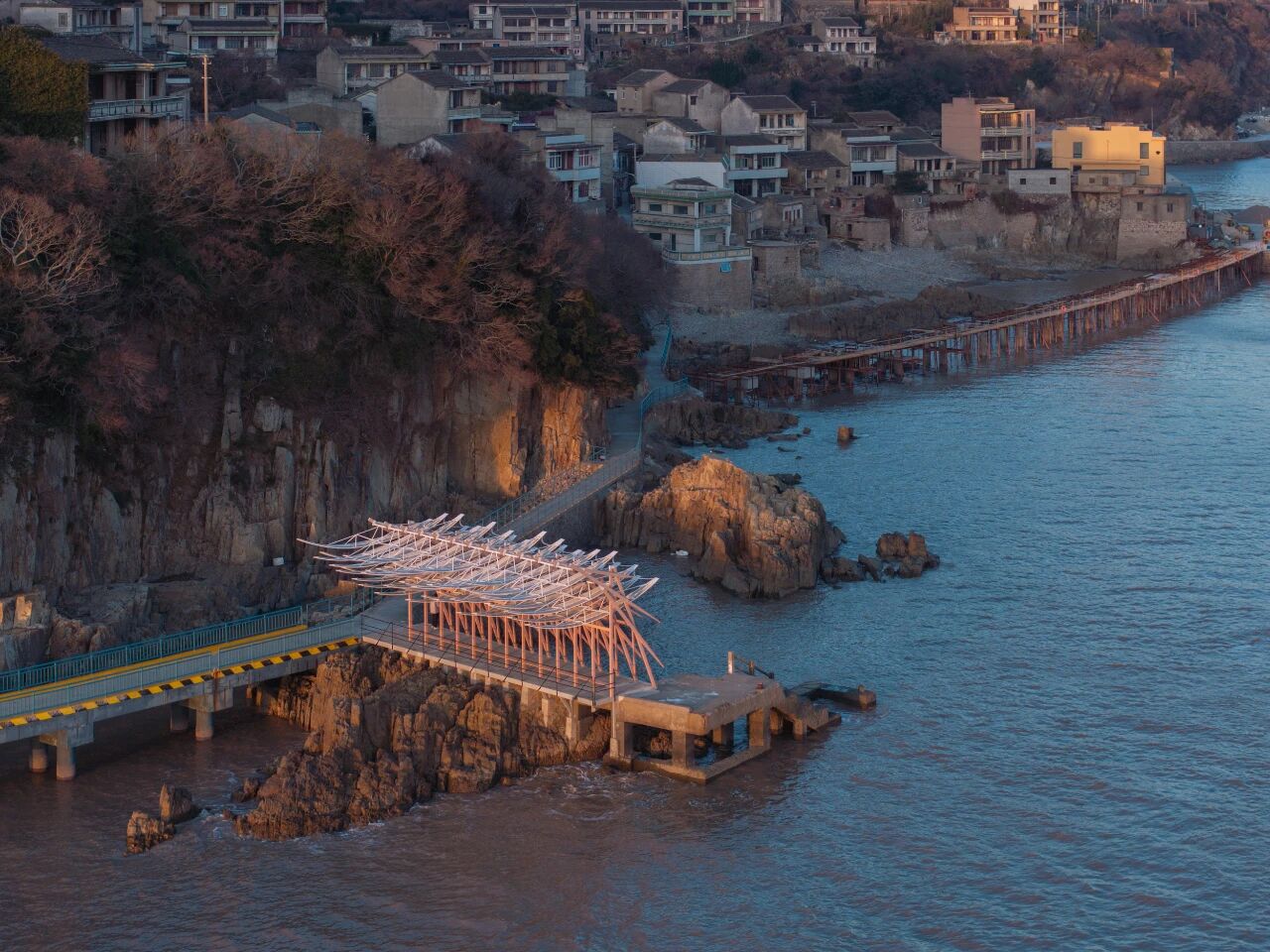
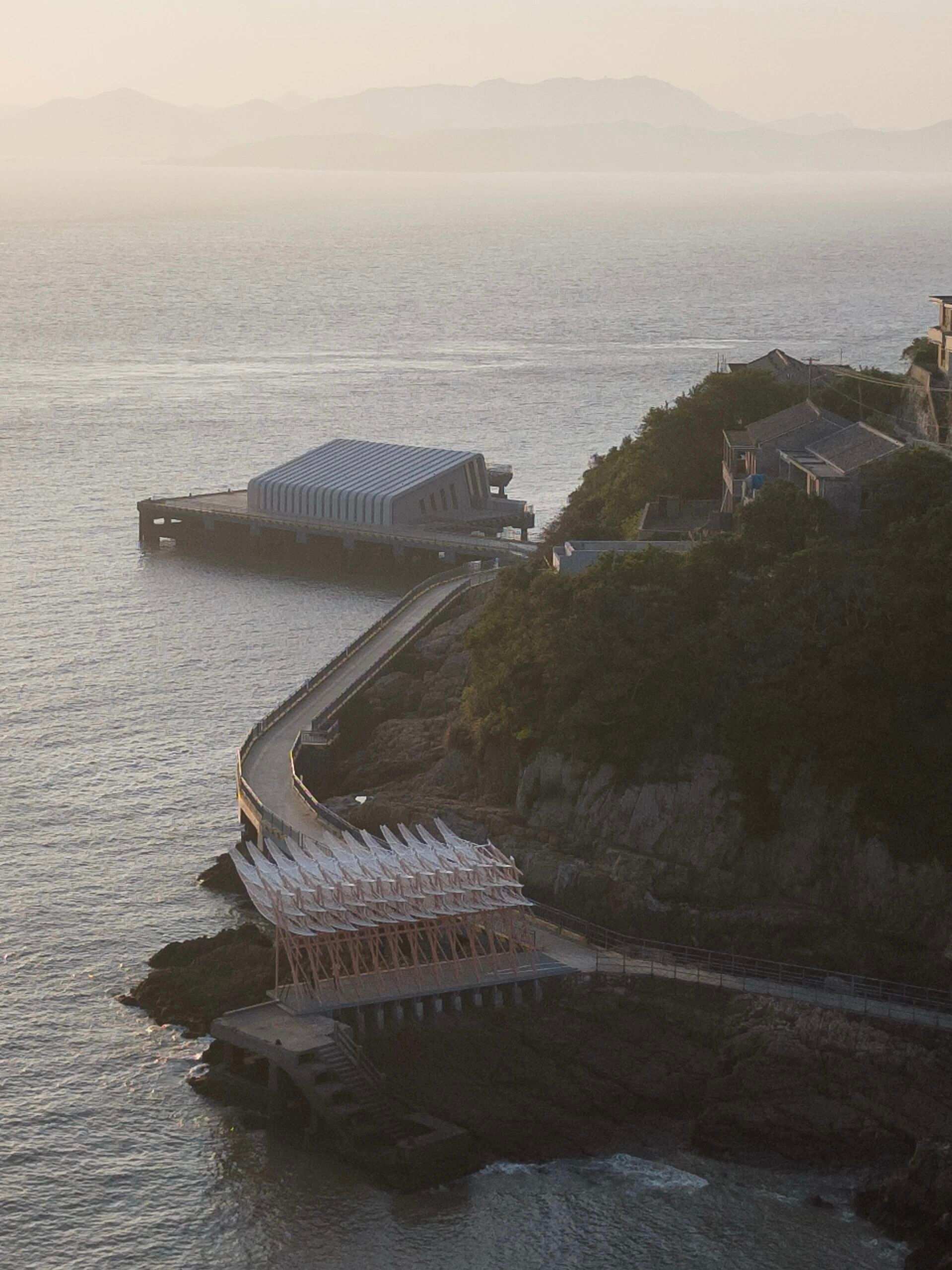
At its busiest, the pier was bright through the night, crowded with boats and bustling with trade. A local saying captured the island’s social landscape:“Gangli people stand at the pier; Houshatou people toil on the mainland; Xiaoshatou people shoulder hoes; Huangshatou people wear buns with cream.”This described the life and pride of Baisha’s islanders. Gangli people were known for their warm hospitality—always standing at the pier early to welcome guests. As fishing declined, boats moved to Shenjiamen, and the once-vibrant port fell silent.
Under the national “Develop Big Islands, Relocate Small Islands” policy, the island’s only school closed, and families gradually moved away. Today, only around 96 elderly residents remain. Yet as the island renews, the gears of a new era begin to turn.
The Pavilion standing at the pier now echoes the image of those islanders long ago—waiting at the dock, greeting arrivals, watching departures.
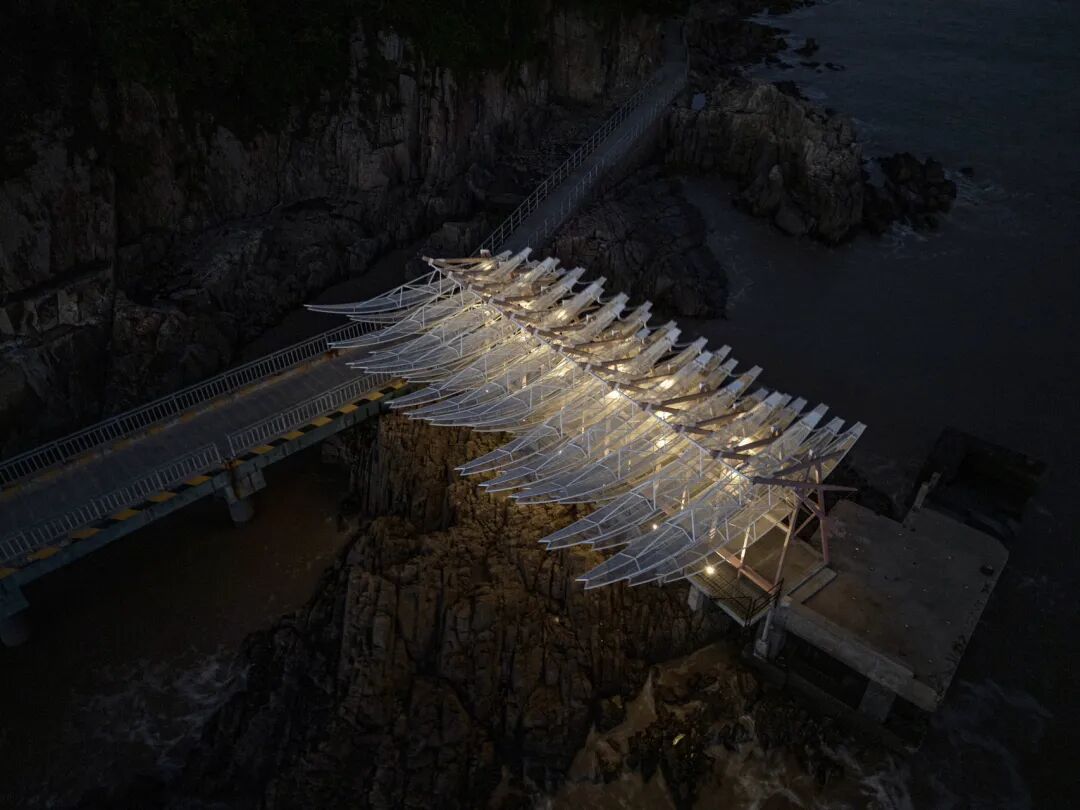
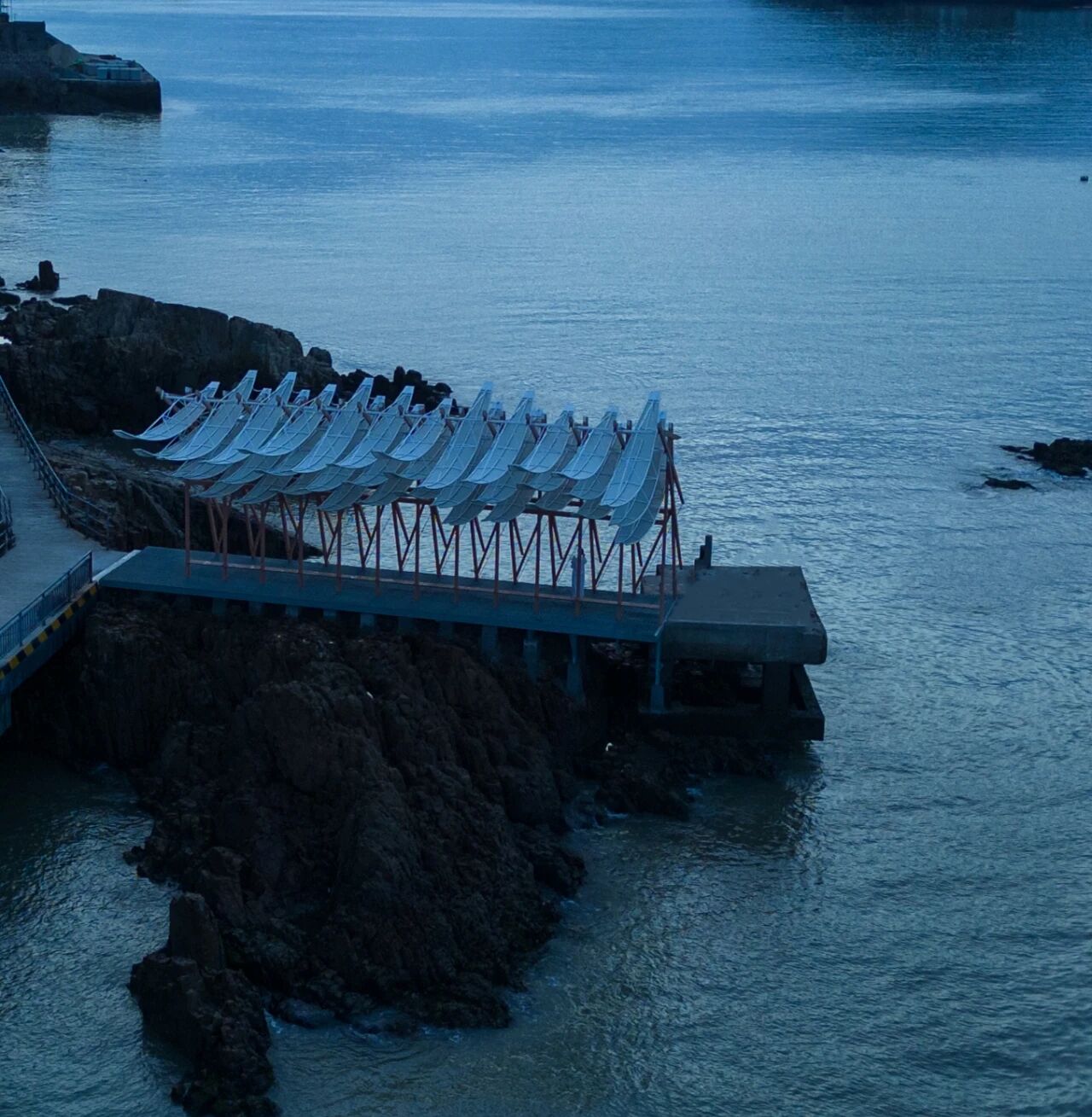
▲ Time flows day and night
Drawings
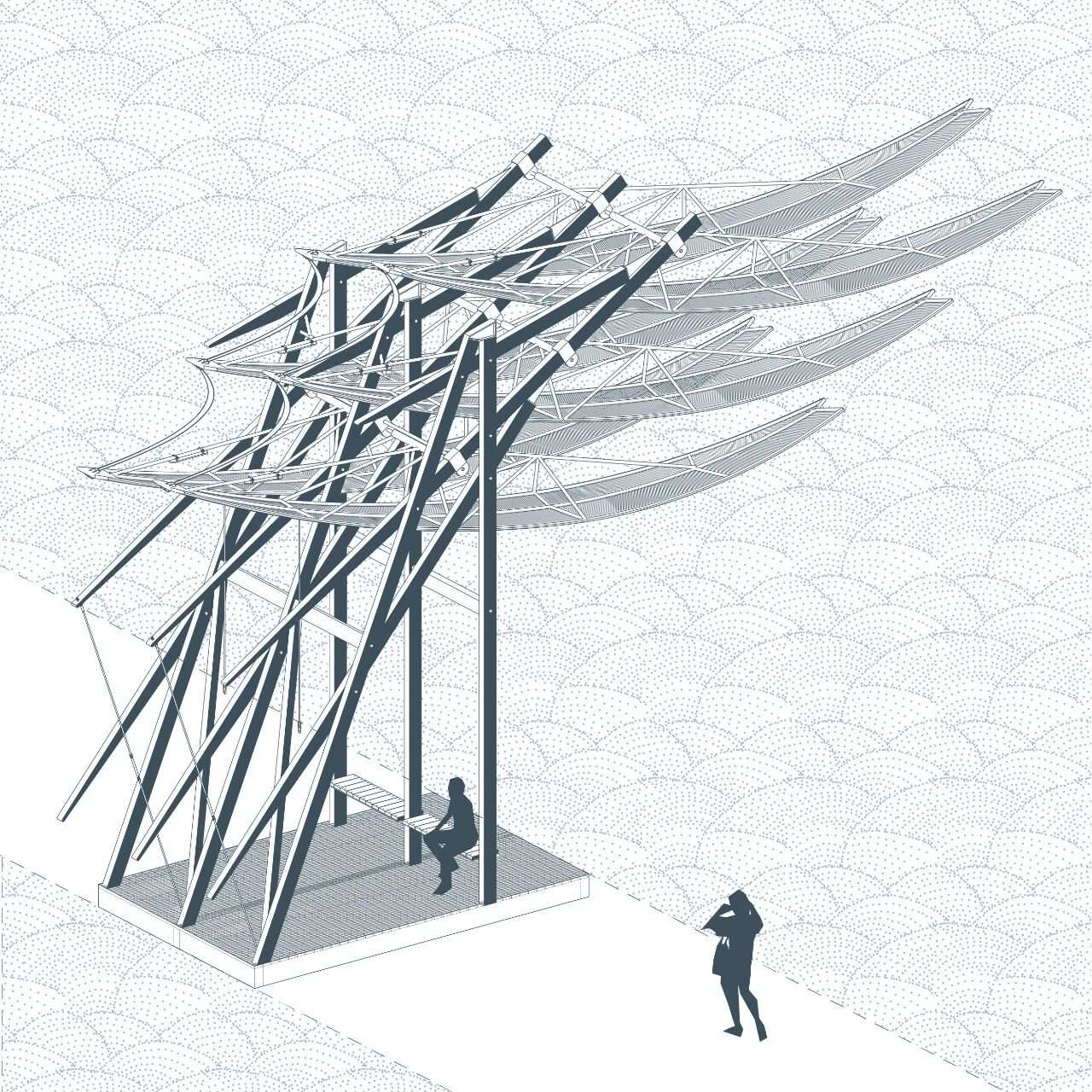
▲ Component details
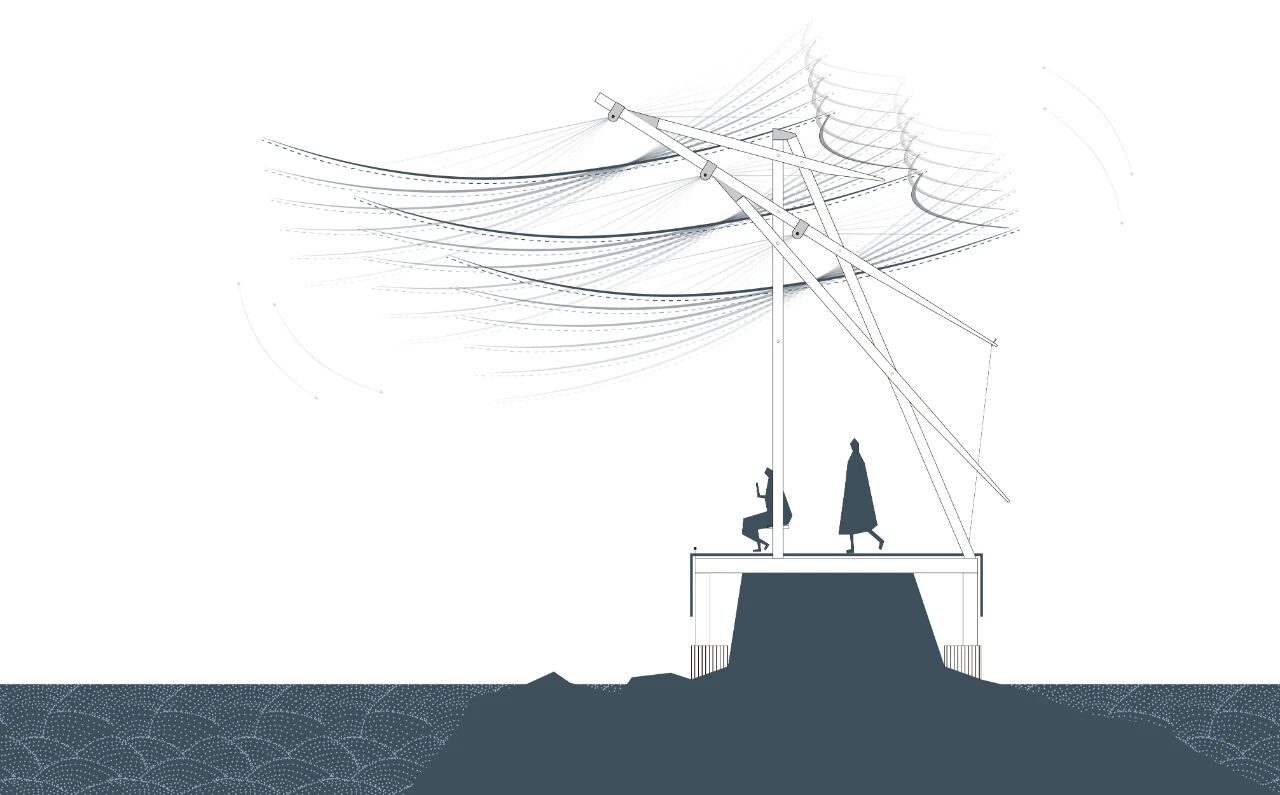
▲ Elevation view
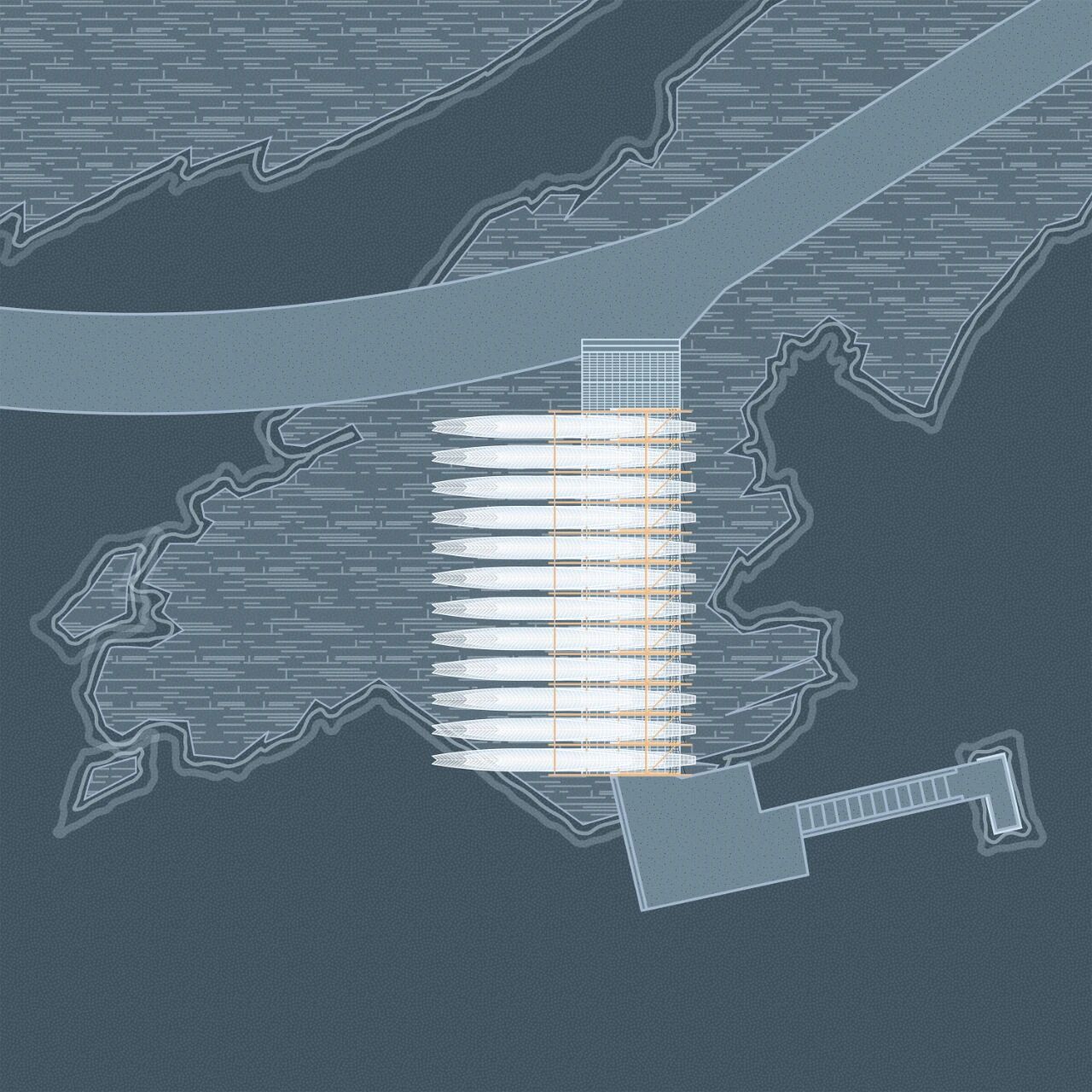
▲ Plan view
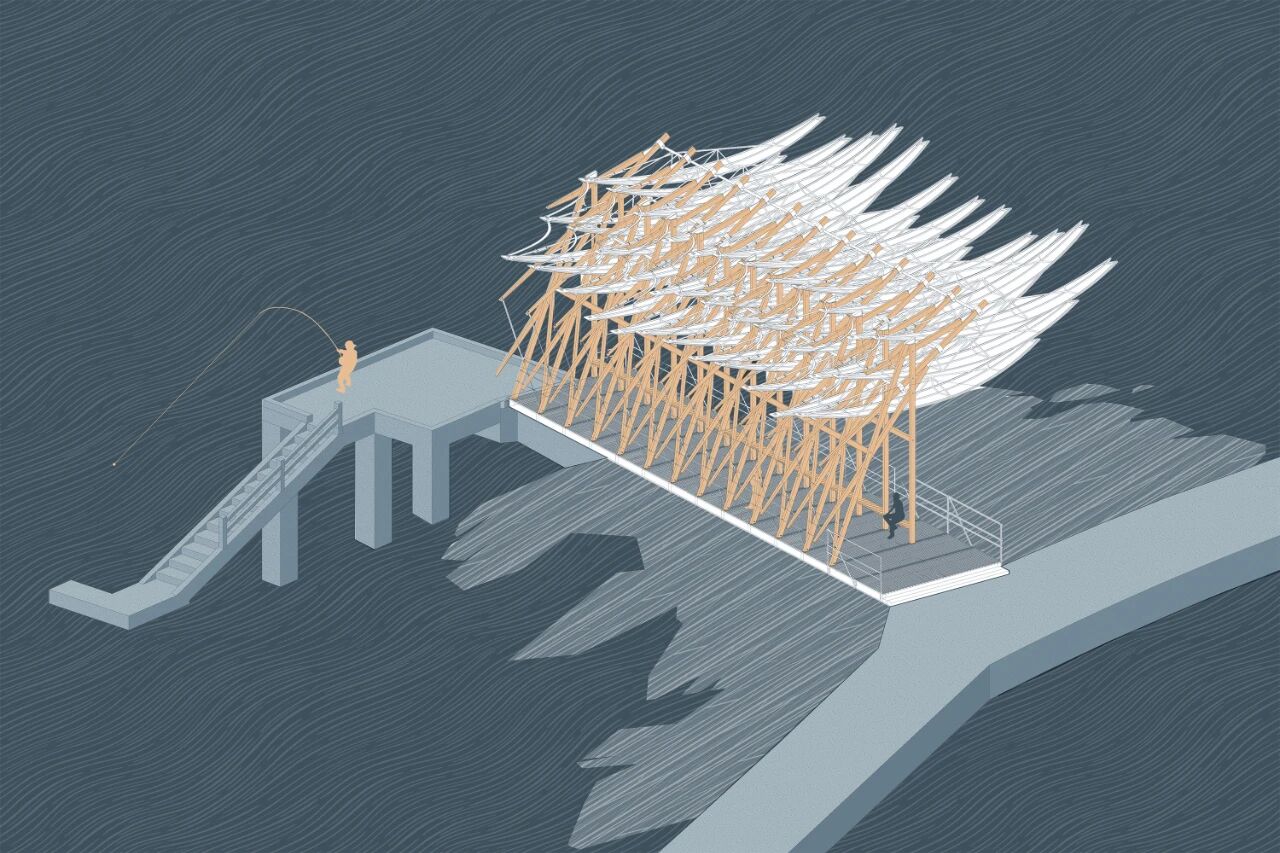
▲ Axonometric view
Project Information
Project Title: Seaside Pavilion, Chaishan Island, Zhoushan
Location: Chaishan Island, Zhoushan, Zhejiang Province, China
Project Type: Art Installation
Competition Organizer: “Hello, Islands” Competition Committee of Zhoushan
Sponsors: Zhoushan Bureau of Culture, Radio, Television, Tourism, and Sports;
ERKE Cultural Development (Zhoushan) Co., Ltd.;
Shanghai Bujiasuo Cultural & Art Co., Ltd.
Client: Baisha Island Administrative Committee, Putuo District, Zhoushan
Design Firm: GN Architects
Design Team: Shen Lijiang, Liu Tong, Cui Hengxuan, Ding Hao, Zheng Zhen
Design Period: July 2023 – May 2024
Construction Period: July 2023 – August 2024
Site Area: 75 ㎡
Construction Contractor: Baoding Shenjiang Sculpture & Craft Manufacturing Co., Ltd.
Photography: Liang Wenjun, Tian Fangfang, Zhang Yong, Jiang Meng
Awards & Honors
RIBA Asia Pacific Awards (Inaugural) Winner
WA World Architecture Awards, Highly Commended
AIA International Design Awards – Inclusive Design Excellence Award (Special Grand Prize)
AIA International Design Awards – Honor Award for Architectural Design (Highest Level)
11th Architectural Creation Award, Shanghai Architectural Society – Excellent Award
un Design Award Landmarks & Symbolic Structures Platinum
ArchDaily Building of the Year & Installation of the Year
Dezeen Top 10 Buildings in China
ArchitizerA+Awards
KPA KUNPENG GLOBAL DESIGN AWARD
Media Coverage
ArchDaily Building of the Year Awards & Best Installation Awards、Dezeen Top 10 Best Chinese Architecture Projects、ArchiDaily、ArchPosition、gooood、Archina、AD China、Dezeen、Architizer、archello、desingboom、yatzer、archilovers、Metalocus
